
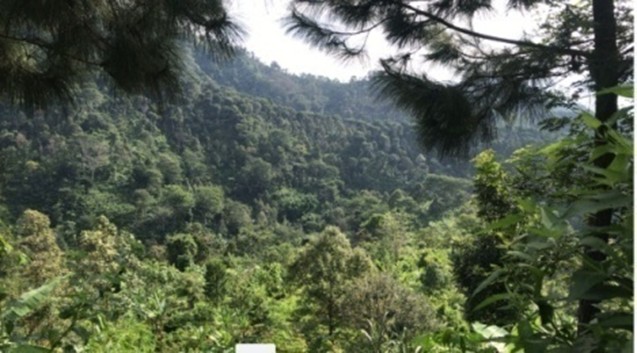

Forests are not merely collections of trees, but also “multi-story homes” for various bird species. A study conducted in the Jelbuk area, Perhutani KPH Jember, found that each bird species has different preferences for tree stratification — ranging from the forest floor and shrubs to the highest canopy layers.
Various bird species with unique lifestyles and feeding habits were recorded in this area. Some feed on fruits, others hunt insects, search for nectar, or act as predators monitoring the forest from above the canopy.
Some bird species recorded during the study include:
- Crested Serpent Eagle (Spilornis cheela)
- Wreathed Hornbill (Rhyticeros undulatus)
- Linchi Swiftlet (Collocalia linchi)
- Sooty-headed Bulbul (Pycnonotus aurigaster)
- Yellow-vented Bulbul (Pycnonotus goiavier)
- Javan Kingfisher (Halcyon cyanoventris)
- Collared Kingfisher (Todiramphus chloris)
- Black-banded Barbet (Megalaima javensis)
- Javan White-eye (Zosterops melanurus)
- Scarlet-headed Flowerpecker (Dicaeum trochileum)
- Bar-winged Prinia (Prinia familiaris)
- Olive-backed Sunbird (Cinnyris jugularis)
- Black-winged Flycatcher-shrike (Hemipus hirundinaceus)
- Javan Munia (Lonchura leucogastroides)
- White-headed Munia (Lonchura maja)
- Red Junglefowl (Gallus gallus)
- Blue-breasted Quail (Synoicus chinensis)
- Plaintive Cuckoo (Cacomantis merulinus)
- Little Forktail (Enicurus velatus)
- Blue-and-white Flycatcher (Cyanoptila cyanomelana)
- and various other species
✨ Fun fact: Birds actually choose their own “floor” within the forest. Some prefer the canopy tops to monitor prey, such as the Crested Serpent Eagle, while others are more active in lower shrubs like the Bar-winged Prinia. Meanwhile, species such as the Linchi Swiftlet continuously fly above the canopy.
🦜 One of the most remarkable species recorded was the Wreathed Hornbill (Rhyticeros undulatus). This large hornbill has a distinctive call that echoes throughout the forest and plays an important role as a natural seed disperser. The Wreathed Hornbill is classified as Vulnerable (VU) by the IUCN, protected under PermenLHK No. P.106 of 2018, and listed in Appendix II of CITES. Its presence indicates that the forest area still maintains good habitat quality.
This study highlights that plant diversity and forest structure are essential for supporting bird life. When trees, shrubs, and forest canopies remain preserved, bird calls will continue to be an inseparable part of Indonesia’s tropical forest ecosystems.